Smartwatch AI spots more hypertension than an office cuff check
Nov 6, 2026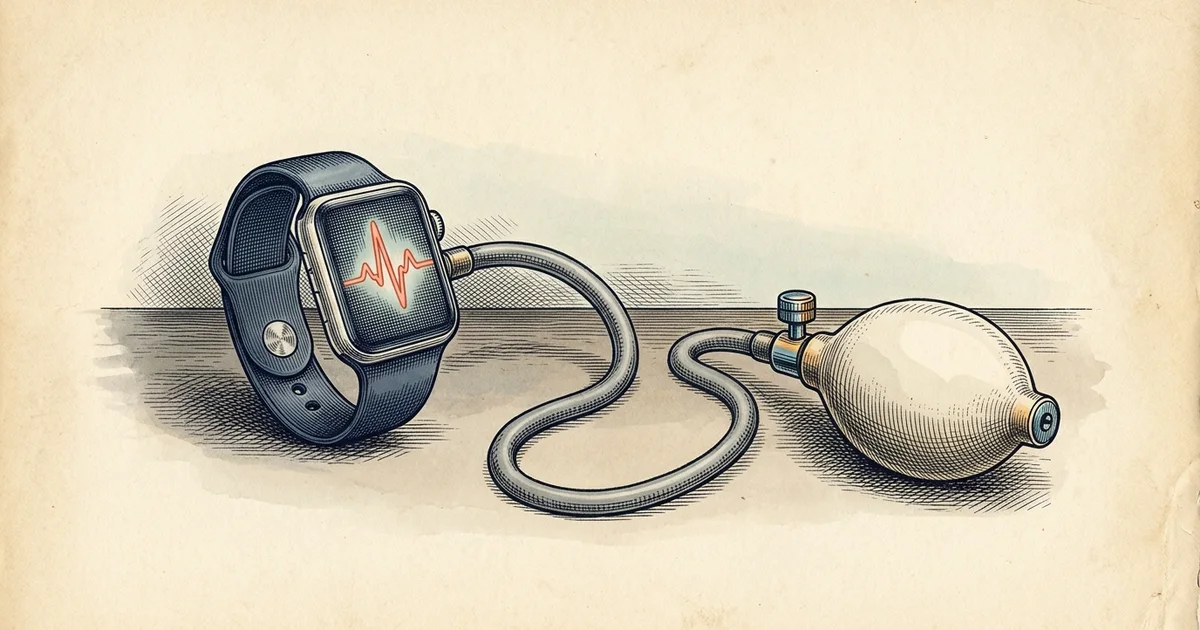
Listen to this post
read by AI voices · all episodesA Google artificial intelligence model reading consumer smartwatch sensors detected 65.8% of hypertension cases over seven days, versus 55.3% for an initial office blood pressure check, in a 196-person study published Thursday in Nature.
Both approaches had 90.0% specificity against 24-hour ambulatory monitoring, and the watch model needed no cuff calibration, the authors reported. Separately, a JAMA study of 5.2 million newborns found that the share not given vitamin K at birth more than doubled from 2017 to 2025, Wisconsin reported its first measles death since 1990, and the Centers for Medicare & Medicaid Services proposed dropping obstetric and emergency readiness training rules for hospitals.
In AI evidence, a 400-person randomized trial in JAMA Network Open found a generative AI maternal health chatbot did not improve anxiety or depression at 12 months, and Mayo Clinic Platform opened a clinical AI chatbot covering more than 35 specialties to Mayo clinicians and outside organizations in its programs.
- FYIEvidence Nov 5, 2026A Google Research model that reads a consumer smartwatch's photoplethysmography and accelerometer signals, with no cuff calibration, detected hypertension with 65.8% sensitivity, 90.0% specificity and an 80.6% positive predictive value over seven days of real-world wear. Initial office blood pressure screening in the same participants reached 55.3% sensitivity, 90.0% specificity and a 77.8% positive predictive value. The prospective multicenter study enrolled 196 adults without known cardiovascular disease or antihypertensive treatment and used 24-hour ambulatory monitoring as the reference. Fifteen of the 16 authors list Google Research affiliations, and the paper describes the tool as a way to prompt at-risk people toward clinical assessment and confirmatory cuff-based diagnosis.Sources: Nature, PubMed record
- FYIEvidence Nov 5, 2026The share of U.S. newborns who did not receive intramuscular vitamin K rose from 3.1% in 2017 to 6.8% in 2025, according to a retrospective JAMA cohort of 5,240,780 infants born at 35 to 43 weeks in the Epic Cosmos dataset. Infants who did not receive it had more bleeding by 6 months (288.0 vs 185.9 per 10,000; adjusted risk ratio 1.47), more intracranial bleeding (33.0 vs 13.2 per 10,000; aRR 2.43) and more deaths with concurrent bleeding during the birth hospitalization (2.9 vs 1.1 per 10,000; aRR 2.69). Bleeding by 6 months in infants without vitamin K rose from 225.3 to 394.0 per 10,000 births over the study period, the Children's Hospital of Philadelphia-led authors reported.Sources: JAMA, PubMed record
- FYIIncident Nov 5, 2026The Wisconsin Department of Health Services reported Thursday the death of an infant in the southwestern Wisconsin measles outbreak; the coroner listed measles as the immediate cause. The state had counted 431 cases in 13 counties in 2026 as of Nov. 3, its highest total in more than 35 years, with nine hospitalizations. Providers have given more than 42,000 MMR doses in the state since Aug. 1, the department said. The death follows a child's death in New York's outbreak reported Nov. 3.
- FYIIncident Nov 2, 2026A Yakima County farmworker with underlying health conditions died Nov. 1 after contracting highly pathogenic avian influenza from an infected animal at a dairy, the Yakima Health District said. Two other Yakima farmworkers infected after dairy exposure have not had severe illness, and animals at 39 more farms in Yakima and Benton counties have tested positive since the first dairy detection in early October, the Washington State Standard reported. "While this is a serious and heartbreaking outcome, the risk to the general public remains low," said Dr. Dave Atteberry, the district's health officer. The previous U.S. death, in November 2025, involved an H5N5 infection in Grays Harbor County, Contagion Live reported.
- WatchRegulation Nov 5, 2026
CMS proposes removing hospital obstetric training and quality rules that would otherwise take effect Jan. 1, 2027.
The Centers for Medicare & Medicaid Services proposed Thursday to remove staff training requirements for emergency services readiness, now in effect, and for obstetric care, otherwise effective Jan. 1, 2027, from the conditions of participation for hospitals and critical access hospitals, along with obstetric-specific quality improvement requirements. The rule would also implement a new statute exempting some critical access hospitals from distance eligibility requirements. CMS is seeking comment on giving facilities flexibility on physician supervision of certified registered nurse anesthetists and on letting physician assistants and nurse practitioners make nursing home visits now required of a physician. CMS estimated the proposals would save $320 million and 3.26 million hours of staff time.Source: CMS fact sheet - FYIEvidence Nov 2, 2026Access to a generative AI maternal health chatbot did not change Generalized Anxiety Disorder-7 scores (adjusted mean difference 0.10; 95% CI, -0.77 to 0.96) or Patient Health Questionnaire-9 scores (-0.23; 95% CI, -1.05 to 0.59) at 12 months, compared with an active control of monthly children's books, in a randomized trial in JAMA Network Open. The trial enrolled 400 pregnant or postpartum participants from racial and ethnic minoritized groups across 49 states and the District of Columbia. The chatbot also made no difference in emergency department visits, postpartum checkups, contraception use or sleep; among those pregnant at enrollment it was associated with more self-reported pregnancy complications in one secondary analysis, which the University of Maryland and National Institutes of Health authors said should be interpreted cautiously.Sources: JAMA Network Open, PubMed record
- FYIDeployment Nov 5, 2026Mayo Clinic Platform, the health system's digital business arm, launched an AI tool that answers clinical questions, parses medical literature and draws on patient data through integrations with several electronic health records, Healthcare Dive reported Thursday. It covers more than 35 specialties and includes 22 clinical calculators usable by message or voice dictation, and it is available to Mayo clinicians and to organizations in Mayo Clinic Platform's provider programs. Mayo said clinicians helped build and test the tool; no accuracy or outcome data were cited.Source: Healthcare Dive
- FYIRegulation Nov 5, 2026PulseAI, a Belfast company, said Thursday that it received FDA 510(k) clearance for an AI arrhythmia analysis model for wearables, focused on atrial fibrillation, that sends recordings to the cloud and returns structured results to an app for clinical review. The company cited a 296-participant prospective study in Heart Rhythm and said its model produced 92% fewer inconclusive readings than the Apple Watch's built-in algorithm; the figures are the company's own. The release did not list sensitivity or specificity or name the specific devices covered.Source: PulseAI release
- FYIEvidence Nov 5, 2026Interruptive electronic health record alerts citing society recommendations against routine preoperative testing did not significantly reduce testing before cataract surgery (adjusted odds ratio 0.68; 95% CI, 0.34-1.34), according to a pragmatic trial at UCLA Health in JAMA Ophthalmology. Testing fell from 83% to 79% of encounters in the alert arms and from 84% to 82% with usual care, across 1,045 preoperative visits by 229 physicians. Clinicians canceled 16% of orders after an alert, and an alert stressing the psychological stress of testing cut complete blood counts (aOR 0.37) and electrocardiograms (aOR 0.42), the authors reported.Sources: JAMA Ophthalmology, PubMed record